Avrupa merkezli casino siteleri yeni altyapısı, Türk oyuncular için düşük ping bağlantısı sunar.
Yepyeni özellikleriyle bettilt giriş versiyonu heyecan veriyor.
Bahis sektöründe kalitesiyle ön bahsegel plana çıkan kullanıcılarını memnun eder.
Bridging Classroom Learning with Real-World Skills
March 19, 2026 2026-03-19 10:28Bridging Classroom Learning with Real-World Skills
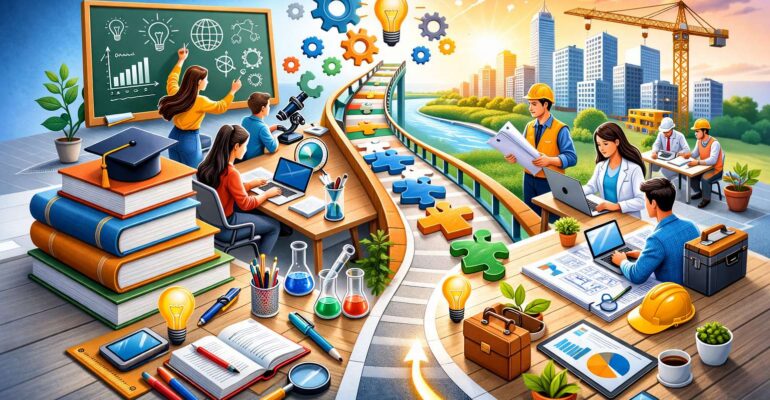
Learning today can no longer be confined to curriculum design and classroom delivery. As AI rapidly reshapes industries and job roles, institutions are among the first to recognise this shift by placing skill enhancement at the centre of their response. The goal is to prepare students for a far more dynamic professional landscape and enable them to quickly adapt to emerging roles. While technical capabilities have become foundational, equal emphasis must be placed on building critical thinking and empathy. These human traits will ultimately determine how effectively we transform AI from a perceived threat into an opportunity that boosts productivity and drives growth.
To survive and thrive in this new economy, students must pivot from simply “mugging up” to applying their knowledge to the best of their abilities in the real world.
True competitiveness now lies at the intersection of “AI fluency” and irreplaceable human intuition. It is no longer enough to know the what; students must master the how: leveraging critical thinking to audit AI outputs, ethical reasoning to navigate complex data, and creative strategy to solve problems that algorithms cannot yet see. These are skills that require practice, mentorship, and real-world context, all of which can be delivered through a carefully designed integrated curriculum in this AI-focused job market.
To help the future workforce achieve this level of professional proficiency, academicians, teacher and educators, must realise that the usage of AI does not render human skills useless. Instead, it makes the skills more valuable. Despite the World Economic Forum previously estimating that 92 million jobs might be displaced by automation, the silver lining remains the emergence of 170 million new roles by 2030. These are not just “tech jobs” in the traditional sense; they are roles defined by human-machine collaboration.
Institutions that have made skill integration an immediate priority are already seeing the results.They are enabling students to bridge the AI readiness gap between what employers expect and what graduates can deliver by embedding practical fluency into their curricula. Hence, students emerging from these programs enter the workforce not just with theoretical knowledge, but with hands-on and practical experience in the tools that now define today’s workforce.
For a nation with one of the youngest and largest student populations, the stakes couldn’t be higher. During the Union Budget 2026-27, the announcement of ‘Education to Employment and Enterprise’ Standing Committee signals a timely effort to strengthen the link between education, skills, and industry demand. By evaluating the impact of emerging technologies and prioritising services sector, it can play a critical role in preparing India’s workforce for future growth.