Science and religion: Reconcilable differences
April 16, 2026 2026-04-16 11:22Science and religion: Reconcilable differences
Science and religion: Reconcilable differences
With the loud protests of a small number of religious groups over teaching scientific concepts like evolution and the Big Bang in public schools, and the equally loud proclamations of a few scientists with personal, anti-religious philosophies, it can sometimes seem as though science and religion are at war. News outlets offer plenty of reports of school board meetings, congressional sessions, and Sunday sermons in which scientists and religious leaders launch attacks at one another. But just how representative are such conflicts? Not very. The attention given to such clashes glosses over the far more numerous cases in which science and religion harmoniously, and even synergistically, coexist.
In fact, people of many different faiths and levels of scientific expertise see no contradiction at all between science and religion. Many simply acknowledge that the two institutions deal with different realms of human experience. Science investigates the natural world, while religion deals with the spiritual and supernatural — hence, the two can be complementary. Many religious organizations have issued statements declaring that there need not be any conflict between religious faith and the scientific perspective on evolution.1
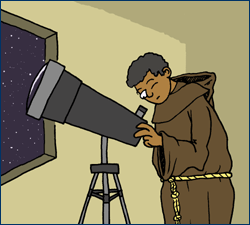
Furthermore, contrary to stereotype, one certainly doesn’t have to be an atheist in order to become a scientist. A 2005 survey of scientists at top research universities found that more than 48% had a religious affiliation and more than 75% believe that religions convey important truths.2 Some scientists — like Francis Collins, former director of the National Human Genome Research Institute, and George Coyne, astronomer and priest — have been outspoken about the satisfaction they find in viewing the world through both a scientific lens and one of personal faith.
This is not to suggest that science and religion never come into conflict. Though the two generally deal with different realms (natural vs. spiritual), disagreements do arise about where the boundaries between these realms lie when dealing with questions at their interface. And sometimes, one side crosses a boundary in its claims. For example, when religious tenets make strong claims about the natural world (e.g., claiming that the world was created in six days, as some literal interpretations of the Bible might require), faith and science can find themselves in conflict.